Showing posts with label fair trade fundraising. Show all posts

When Fundraising, why choose friendship bracelets? Fair Trade as a profitable alternative

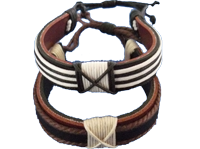
fundraising bracelets
As I am becoming aware of our global communities, I am continually amazed and distressed by the stories that I hear about the conditions people will endure so that their families can have a better life. Equally, I am shocked and disturbed by the greed that dwells in the depths of the human heart that will take every advantage of the weak just to make money.

I am yet to find one industry that hasn't be tainted in some way by the exploitation of workers. To this point fundraising is not exempt from this. In fact, the manufacturing of chocolate - the fundraiser of choice for many- has been one of the biggest offenders of unfair working conditions globally. While, the chocolate industry is currently going through an overhaul, there is still a long way to go before we can be assured that our food for "love" can be as it is claimed.


For that matter, the latex used to manufacture fundraising bracelets is also a bit of a "fair trade" mystery. With the majority of latex these days manufactured using petroleum, only about 25% of rubber is derived from forest plantations. Historically these plantations have been notorious for the way that they treat their workers, with large business' like goodyear leading the way in the mistreatment. 

Today, however, much of the natural rubber is still made from trees in developing nations. While many of the plantations are run by family business, it is their claim that the working conditions are good and their employees are paid fairly for what they do. With no certification process in place for many of these manufacturers and understanding the heart of man, I find it difficult to believe that out of the goodness of their heart with no pressure from industry that a fair trading model would be established. Either the multinationals will be screwing the prices or the manufacturer would be pocketing the profit. It just doesn't add up with the history of man that anything but greed will be driving the economics of rubber.

So to this end, if you consider that how a product is made is important to your fundraising campaign, then it may be valuable to check out which ones follow a fair trading protocol. Now not all business have the "fair trade" label should be discounted. Sometimes you can simply ask "how do you make your product?" and "where does your product come from?" If they dont have a quick response to that questions, or they are a bit like Nike and try to avoid the answer, then it may be worth considering an alternative. I would certainly be dubious about any business that doesn't have a clear position on the working conditions of employees and sub-contractors.


If you would like to know more about how "fair trade" can be combined with a fundraising program, visit 1hope fundraising and check out their fundraising bracelets.

Why Fairtrade?

Fair trade is all about providing a better economic balance between first world consumers and producers from developing nations.

Defined as a "trading partnership, based on dialogue, transparency and respect, that seeks greater equity in international trade. It contributes to sustainable development by offering better trading conditions to, and securing the rights of, marginalized producers and workers – especially in the South. Fair trade organizations, backed by consumers, are engaged actively in supporting producers, awareness raising and in campaigning for changes in the rules and practice of conventional international trade." FINE, 2008

Conventional international trade models have seen multinationals largely abandoned social responsibility for shareholder confidence and the bottomline. For example, it is reported that child workers in Indonesian are earning 22c an hour to make the world famous Nike Air sports shoe which are eventually sold in the US for $125. Walmart, the worldest largest chain od discount variety stores, has for many years been criticised for their involvement in exploitating workers just so they can bring cheaper prices to the consumer. The catch cry for these large business' is that they cannot be responsible for how sub-contractors manage their factories, obsolving themselves of all wrong.

Since the second half of the 20th century however the fair trade movement has been growing steadily and in many cases have become well organised. The result has seen an in increasing pressure on business' like Nike and Wal-Mart to be social responsible. In the 1940's groups like ten thousand villages began to sell handicrafts at local churches and fetes. The trade was often identified more as a donation rather than a robust economic model of supply and demand. In the 60's the fair trade movement spread through Europe as more people identified weaknesses in the existing trading models. With the development of Alternative Trade Organisations and the introduction of worldshops saw the alternative trade blossum. However, the novelty started to wear off by the 80's.

Not until the introduction of fairtrade certification initiatives did the sale of fair trade products start to really gain momentum. The introduction of fairtrade certification allowed more mainstream products to receive approval and consequently opened the market for many fair trade products. By 1997 fair trade labels could be seen on products like coffee, tea, rice, bananas, mangoes, cocoa, cotton, sugar, honey, fruit juices, nuts, fresh fruit, quinoa, herbs and spices, wine, and footballs.

Global Fairtrade in 2008
The global market for Fairtrade certified products experienced significant growth in 2008 despite the onset of the global recession. Fairtrade sales grew by an impressive 22% as consumers spent an estimated 2.9 billion Euros on Fairtrade products globally.

Major growth was experienced across all main Fairtrade product categories.  Global sales have doubled for Fairtrade tea (112%) and for Fairtrade cotton products (94%).  As the products with the highest sales volumes, Fairtrade coffee sales increased 14% to 66,000 metric tonnes (MT) and the market for Fairtrade bananas grew by 28% to 300,000 MT.

Fairtrade sales grew by at least 50% in seven countries, including Australia and New Zealand (72%), Canada (67%), Finland (57%), Germany (50%), Norway (73%), and Sweden (75%).  The largest markets for Fairtrade products continued to experience strong growth, as sales of Fairtrade certified products increased by 43% in the United Kingdom and 10% in the United States.  Fairtrade products also gained popularity in a number of new markets, including in Eastern Europe, Eastern Asia, and South Africa.

In 2008, the Fairtrade Premium contributed over 12 million Euros to Fairtrade coffee farmers and over 11 million Euros to Fairtrade banana farmers alone.

As of the end of 2008, there were 746 Fairtrade certified producer organizations representing over one million individual farmers and workers.  There are at least another 70,000 members of affiliated organizations that belong to Fairtrade certified producer groups that also benefit from Fairtrade, which include women’s groups and other groups not directly involved in the production of Fairtrade products, like cattle herders. Including family members, it is estimated that over five million people directly benefit from Fairtrade.
FTA

With the such a wonderful increase in the choices we now have for fair trade labels, the question should no longer be why fair trade. It should really be restated as why not?

If you want to know more about how "fair trade" can marry well with fundraising campaigns check out the fundraising bracelets by 1hope fundraising. They also have a great fair trade educational program that will help to bring awareness about social justice issues and how fair trade makes a difference.